
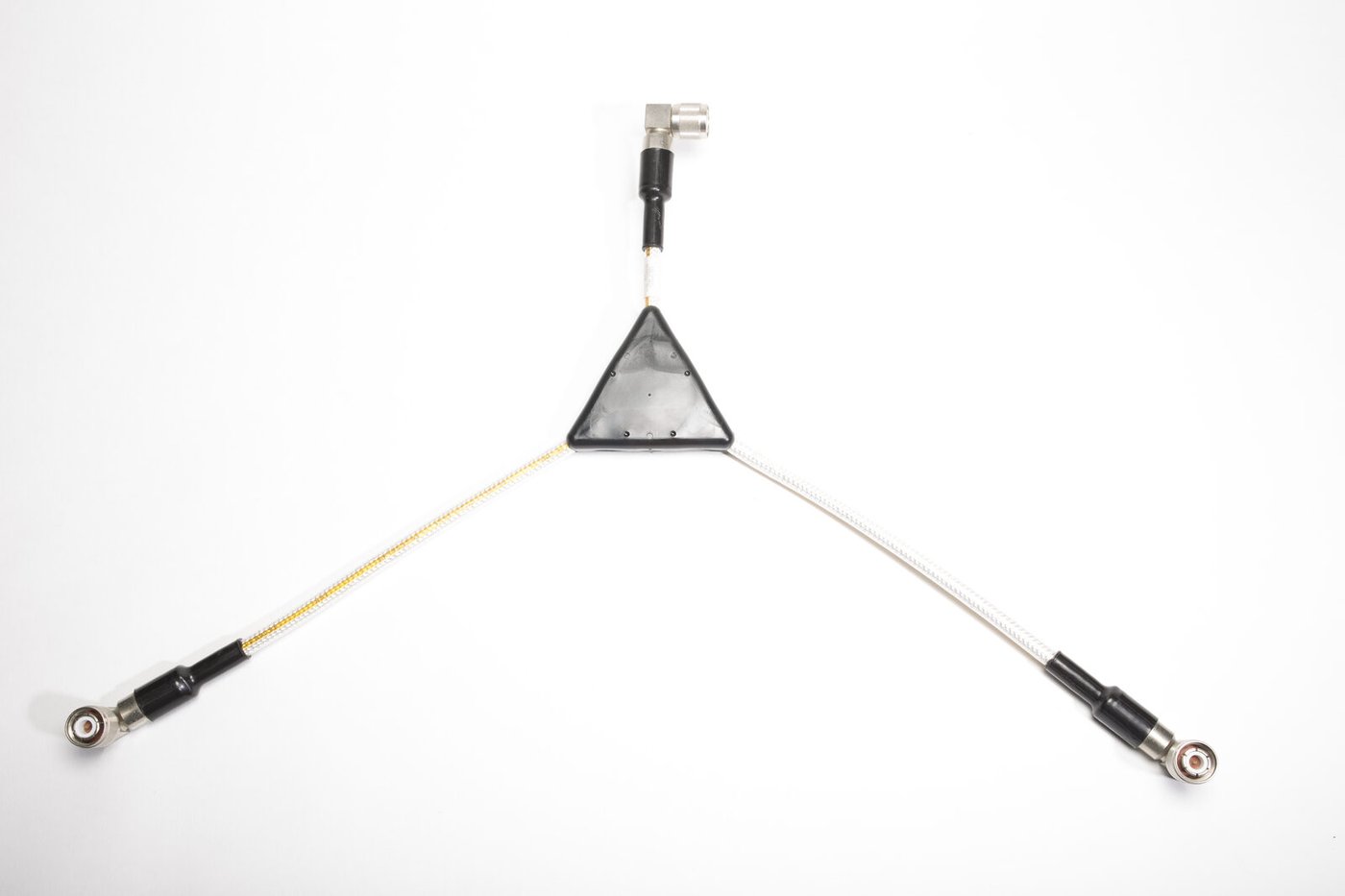
A high-voltage cable assembly that passes sea-level testing cannot be assumed to perform safely at altitude. As air pressure falls, gas breakdown voltage changes nonlinearly with the pressure-gap product — and the worst-case altitude for corona inception is often not the highest altitude. The physics is well established, the failure modes are predictable, and they can usually be prevented or detected with the correct design and qualification approach.
Altitude performance · 10 kV–250 kV DC · Aerospace, defense, high-altitude UAV
Paschen's Law — What It Says and What It Doesn't
The relationship between gas pressure, electrode gap, and electrical breakdown voltage was characterized empirically by Friedrich Paschen in 1889. Paschen's Law states that the breakdown voltage of a gas is a function of the product of pressure (p) and gap distance (d) — not of pressure or gap distance independently. This has two important consequences for high-voltage assembly design.
First: as pressure decreases at constant gap, the pd product decreases. Over part of the Paschen curve, this lowers the breakdown voltage — so an air gap that is acceptable at sea level may have substantially less corona / breakdown margin at altitude. The amount of reduction cannot be predicted by a simple linear pressure correction; it depends on the effective gap dimension, gas composition, electrode geometry, surface condition, and field uniformity. Under a standard-atmosphere model, ambient pressure at 70,000 ft is approximately 4.4 kPa — roughly 4% of sea-level pressure (101.3 kPa) — and the dielectric margin of any unresolved air gap at this pressure can be a small fraction of the sea-level value.
Second, and less intuitively: the relationship is not monotonic. The Paschen curve has a minimum — a specific pd value at which breakdown voltage is lowest. Below that minimum, as pressure decreases further, breakdown voltage rises again. This means that for practical gap geometries in an aircraft assembly, there exists a specific altitude at which corona inception voltage is at its minimum, and that altitude may be well below the maximum operating altitude.
The Physics Behind the Paschen Curve
Gas breakdown via the Townsend avalanche mechanism requires that electrons accelerated by the electric field gain sufficient energy between collisions to ionize gas molecules, generating secondary electrons that sustain the discharge. At high pressure, frequent collisions prevent electrons from accumulating enough energy — breakdown voltage is high. At very low pressure, mean free path becomes long and electrons travel far between collisions, again requiring higher voltage to sustain an avalanche — breakdown voltage rises. At intermediate pressure, the collision rate and electron energy are optimally matched for avalanche initiation — this is the Paschen minimum. The pressure at which the minimum occurs is a function of the pressure-gap product (pd), so the equivalent altitude depends directly on the effective gap dimension. For small interface gaps in connector geometries, the minimum may fall in the pressure range corresponding to high aircraft altitudes; for larger gaps, the minimum occurs at much lower pressures. There is no universal "Paschen minimum altitude."
What "Altitude Performance" Means in Practice — Precise Definitions
Several terms are used loosely in this domain and are worth stating precisely, because the distinctions affect how tests are specified and interpreted.
- Corona inception voltage (CIV) / Partial discharge inception voltage (PDIV). PDIV is the voltage at which measurable PD activity first appears under defined test conditions. CIV is commonly used when the discharge mechanism is corona in gas. The operationally critical threshold is the same in either framing: a high-voltage assembly should not exhibit detectable PD at or below its rated operating voltage, under any operating condition including altitude. In production practice, many "corona tests" are not true inception-voltage measurements — they are no-discharge screens at a specified test voltage and detection threshold. Caton's production corona testing ramps to measured CIV rather than screening at a fixed voltage. IEC 60270 defines PD measurement methods and the PDIV concept formally.
- Paschen minimum. The pressure-gap product (pd) at which breakdown voltage is lowest for a given gas and electrode condition. This is not the same as maximum altitude. The equivalent altitude depends entirely on the effective gap dimension: a 0.1 mm gap, a 1 mm gap, and a 10 mm gap do not reach their Paschen minimum at the same altitude. Assemblies that operate across reduced-pressure environments should be evaluated at the pressure range corresponding to credible worst-case gaps in the specific design — not only at sea level and maximum rated altitude.
- Decompression / rapid decompression. RTCA DO-160G Section 4 defines altitude qualification categories for airborne equipment, including rapid decompression testing for equipment in potentially depressurizing compartments. This is a separate test from steady-state altitude corona testing but is part of the same qualification envelope for pressurized-airframe applications.
- Sealed vs. vented enclosures. An assembly in a hermetically sealed enclosure maintains its internal pressure regardless of external altitude. An assembly in a vented enclosure — or with any air-exposed interfaces — will equilibrate to ambient pressure. Most connector interfaces are not hermetically sealed, which is why altitude performance of the interface is a design concern even for internally pressurized assemblies.
Where the Failures Start — The Three Altitude-Sensitive Locations
Air at the connector mating interface
The connector mating interface is the most altitude-sensitive location in a typical high-voltage cable assembly. In most conventional connector designs, the interface between the male and female insulation bodies is not perfectly conformal — some air is present at the interface, whether by design or by the dimensional tolerances of assembled parts. At sea level, this air gap may have adequate dielectric strength for the operating voltage. At altitude, the same gap has a fraction of its sea-level dielectric strength.
Caton's tapered conical mating geometry is specifically designed to address this mechanism. When the plug engages the receptacle, the tapered geometry progressively displaces air from the interface as the mating surfaces come into contact. The design objective is a controlled solid-dielectric interface with no uncontrolled air gap in the high-field region — so that corona inception behavior at altitude is governed by the solid insulation rather than a trapped air gap. Altitude performance is then verified by test under defined voltage, pressure, and mating conditions.
Voids and interfaces in the termination region
Any air void in the termination region — in potting compound, at the cable-to-connector insulation interface, or at the shield cutback — is altitude-sensitive. Voids that are electrically inactive at sea level, because the field intensity in the trapped air is below the sea-level breakdown threshold, may become active corona sites at altitude when the same field intensity exceeds the reduced breakdown threshold of the lower-pressure air.
This is why altitude testing cannot substitute for void control. Testing at altitude will detect voids that produce corona — but corona in the termination region indicates a design or fabrication problem, not a margin that can be managed by limiting operating conditions. The correct design objective is to avoid air-filled voids in electrically stressed regions, minimize trapped gas at interfaces, and verify adequate corona / PD margin under the relevant pressure conditions.
The external surface of the assembly
For assemblies with insufficient outer insulation thickness, or with sharp external features that concentrate the external fringing field, external corona can occur in the air surrounding the assembly at altitude even if the internal insulation system is well-controlled. The field at the outer surface is determined by the insulation geometry and the operating voltage. At altitude, the threshold for corona inception in the surrounding air falls — and assemblies with marginal external field control may exhibit external corona at altitude that is not present at sea level.
Critical Design Point — The Paschen Minimum Is Not at Maximum Altitude
For many practical high-voltage assemblies, the lowest corona inception voltage occurs at an intermediate pressure — not necessarily at the highest operating altitude. The pressure at which the Paschen minimum occurs depends on the effective gap dimension in the specific design, and may fall within, below, or above the rated operating altitude range. An assembly qualified only at sea level and maximum altitude may not have been evaluated at the worst-case condition. RTCA DO-160G Section 4 altitude categories peak at 70,000 ft; qualification testing for high-voltage assemblies intended to fly through or operate near reduced-pressure environments should include the pressure range corresponding to credible worst-case gaps, not only the test endpoints.
Altitude, Pressure, and the Implication for Air Gap Dielectric Strength
The table below shows representative ambient pressure at several altitudes. The relationship between pressure and air dielectric strength is not strictly linear — the Paschen curve captures the nonlinear behavior — but the pressure values illustrate the order-of-magnitude reduction that is relevant to design margins.
| Altitude | Approx. Pressure | % of Sea Level | Design Implication |
|---|---|---|---|
| Sea level | 101.3 kPa / 760 torr | 100% | Baseline. Sea-level corona testing defines minimum performance only. |
| 15,000 ft | 57.2 kPa / 429 torr | 56% | Pressurized cabin equivalent per DO-160 Category A. Air dielectric strength reduced but well above Paschen minimum for most credible gaps. |
| 35,000 ft | 23.8 kPa / 179 torr | 24% | Typical commercial cruise altitude. Unpressurized bays may be at this pressure. |
| 50,000 ft | 11.6 kPa / 87 torr | 11.4% | High-altitude UAV and reconnaissance regime. Approaches Paschen minimum for some larger gap geometries. |
| 70,000 ft | 4.4 kPa / 33 torr | 4.4% | RTCA DO-160 maximum altitude category. Paschen minimum regime for credible mm-scale interface gaps in many connector designs — evaluate explicitly for the specific gap geometry. |
| 80,000 ft | 2.8 kPa / 21 torr | 2.7% | Unpressurized high-altitude regime. May correspond to Paschen minimum for smaller interface gaps. |
| 100,000 ft | 1.1 kPa / 8 torr | 1.1% | Breakdown voltage rises on left side of Paschen curve for many gap sizes. Space systems may operate in this regime; design per NASA-HDBK-4007A. |
Pressure values calculated from the U.S. Standard Atmosphere 1976 (ISA). The Paschen minimum pressure depends on the specific gap geometry and gas composition — there is no universal Paschen-minimum altitude. Assemblies with credible air gaps in the high-field region should be evaluated at the pressure range corresponding to the worst-case pd for that gap, in addition to sea-level and maximum-altitude endpoints.
Why Sea-Level Test Data Cannot Predict Altitude Performance
A corona inception voltage measurement taken at sea level characterizes the insulation system at 101.3 kPa. It does not provide a basis for predicting PDIV at reduced pressure, for two reasons.
First, the Paschen curve is nonlinear. There is no simple scaling factor from sea-level PDIV to altitude PDIV — the relationship depends on the specific pd product at the worst-case gap in the assembly, and that relationship varies with geometry. An assembly with a 1 mm interface gap behaves differently on the Paschen curve than one with a 0.1 mm gap at the same operating voltage.
Second, sea-level testing does not exercise all failure modes. A void that is too small to produce detectable corona at sea level — because the local field intensity falls below the 3 kV/mm breakdown threshold of air at 101.3 kPa — may become an active corona site at altitude when the effective breakdown threshold drops to a fraction of that value. Sea-level testing cannot detect incipient altitude-sensitive voids. Only altitude testing, performed with corona detection instrumentation, reveals these sites.
This is the reason NASA-HDBK-4007A — the authoritative technical handbook on Paschen and corona design for reduced-pressure high-voltage systems — recommends that designs intended for reduced-pressure environments be analyzed using the Paschen curve for the specific gap geometries present, and qualified by test at the pressures corresponding to the Paschen minimum for those geometries, not only at the minimum operating pressure.
How Caton Addresses It — Design and Qualification Controls for Altitude Performance
- Tapered conical mating geometry that displaces air during seating. Caton's connector mating interface uses a tapered conical geometry intended to progressively displace air from the interface as the plug seats. The design objective is a controlled solid-dielectric interface with no uncontrolled air gap in the high-field region. When that objective is met, corona inception behavior at altitude is governed primarily by the solid insulation system, with far less sensitivity to ambient pressure. Altitude corona performance is then verified by test under defined voltage, pressure, and mating-condition requirements.
- Termination void control through overmolding and vacuum potting. Voids in the termination region are altitude-sensitive: a void that produces no detectable corona at sea level may become an active discharge site near the worst-case pressure for that void geometry. Caton reduces termination void risk through in-house overmolded insulation (for single-conductor designs) and vacuum-applied potting (for multi-conductor backshell configurations) — both of which substantially reduce void risk and improve dielectric continuity compared with atmospheric potting. Process controls and corona / PD testing are used to verify the completed assembly.
- In-house altitude chamber qualification testing. Caton performs altitude simulation testing in a Tenny environmental chamber, reducing internal pressure to simulate the ambient conditions corresponding to the application's operating altitude. Altitude testing is performed at operating voltage with corona detection instrumentation. This confirms that the complete assembly — including the mating interface, termination regions, and connector body — exhibits no corona activity at the simulated operating pressure. For programs with altitude performance requirements, this test is part of design qualification and can be specified as a production acceptance requirement.
- Paschen minimum analysis as part of the design review. For assemblies with altitude requirements, Caton identifies credible gap geometries in the assembly — both internal and at the mating interface — and determines the pd product at the Paschen minimum for each. This analysis confirms that the qualification test plan includes the relevant worst-case pressure, not just sea level and maximum altitude. Designs that control air at the interface and in the termination region are far less sensitive to the Paschen minimum — this analysis is most consequential for designs where any uncontrolled air remains in the field path.
- 100% production corona testing on applicable high-voltage assemblies. Every applicable high-voltage production assembly is corona-tested in one of Caton's four production test cages. The test ramps to measured corona inception voltage (CIV) and verifies adequate margin above the rated operating voltage before the assembly ships. For programs with altitude requirements, altitude chamber testing is performed on qualification units; sea-level production corona testing provides the ongoing screen that each unit is free of the void-related defects that would become altitude-sensitive failure sites.
What to Ask Your Current or Prospective Supplier
These questions help distinguish suppliers who have thought through altitude performance from those who are applying sea-level high-voltage practice to an altitude application. A supplier without altitude engineering experience may not be able to answer questions 2 through 5 from their own design or test data.
- Is the connector mating interface designed to control air at the mated insulation contact — and is the corona inception behavior at altitude governed by solid insulation or by an air gap at the interface? Ask for the specific mechanism and the test evidence.
- Has this assembly been tested at the ambient pressure corresponding to the rated operating altitude, at operating voltage, with corona detection instrumentation? What were the results?
- Have you analyzed the Paschen minimum for the gap geometries present in this assembly? At what altitude does the worst-case corona inception voltage occur — and has the assembly been tested at that pressure?
- How do you control air voids in the termination region? Specifically: overmolded insulation, vacuum potting, or atmospheric-applied potting? What process controls and test evidence support void control in the finished assembly?
- For assemblies in partially pressurized or vented airframe compartments: has external corona performance been evaluated? Is the external field gradient at the outer surface of the assembly adequate for the lowest ambient pressure the assembly will experience?
- Is altitude qualification testing performed in-house, or subcontracted? Who controls the test parameters and acceptance criteria, and can we review the test procedure and results?
Technical References
- NASA-HDBK-4007A (2026). Spacecraft High-Voltage Paschen and Corona Design Handbook. NASA, current revision. The authoritative technical handbook for Paschen and corona design in reduced-pressure environments. Covers the Paschen curve for multiple gases, design methodologies for managing corona at the Paschen minimum, and test procedures for qualification. Publicly available at standards.nasa.gov.
- Paschen, F. (1889). "Ueber die zum Funkenübergang in Luft, Wasserstoff und Kohlensäure bei verschiedenen Drucken erforderliche Potentialdifferenz." Annalen der Physik, 273(5), 69–96. The original empirical paper establishing the relationship between gas pressure, gap distance, and breakdown voltage.
- RTCA DO-160G (2010), Section 4. Environmental Conditions and Test Procedures for Airborne Equipment — Temperature and Altitude. RTCA, 2010 (with Change 1, 2014). Defines altitude qualification categories for airborne equipment, including test altitude levels up to 70,000 ft and rapid decompression procedures.
- Ferguson, D.C. & Hillard, G.B. (2003). Paschen Considerations for High Altitude Airships. NASA/TM-2003-212597. NASA Glenn Research Center. Directly addresses the Paschen minimum in the 70,000-foot altitude regime. Available via NASA NTRS.
- IEC 60270:2000+AMD1:2015 CSV. High-voltage test techniques — Partial discharge measurements. IEC, consolidated edition. Defines measurement methods for partial discharge, including the formal definition of partial discharge inception voltage (PDIV) and extinction voltage (PDEV).
References are provided to support the technical claims in this application note and to allow engineers to verify source material independently. Where standards are cited, the edition current at time of publication applies. Contact our engineering team with questions about how any reference applies to a specific application.